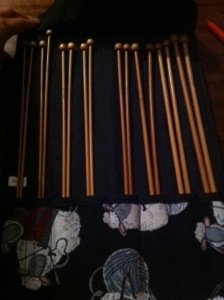
Have just finished and stitched on the tenth panel. Has taken me a little longer than expected, but done never the less. I have found that the metal knitting needles have felt too heavy and my wrists are sore. With this in mind, have found some bamboo knitting needles.
These are definitely different. The wool is held more tightly and there is something warmer about them. Much lighter than the metal ones too.
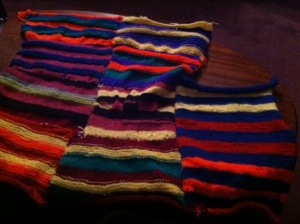
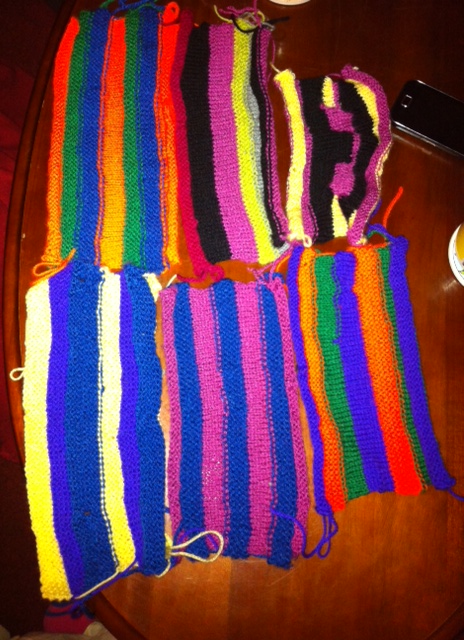
The project is taking shape. This afternoon, I have rather painstakingly stitched together nine panels. Eight of three were the smaller panels that were seven stripes long. The ninth panel is actually fourteen stripes long. Not looking too bad. It’s meant to look wibbly wobbly; different textures are also part of the plan 🙂
Finally, the cover for the 4TB has arrived. A little bigger than expected, but that is a lot better than smaller. I had purchased one that did turn out to be smaller, and of no use. This may be bigger, but it is also made of the same reinforced material as the wendy house and the poly tunnel. I am hoping, therein, that it lasts a while. That said, the cover that was replaced is in fact five years old. Apparently, the shop that made the 4TB has changed the dimensions, so I couldn’t an appropriate replacement. That said, to their credit, the company was very good about making amends. In the poly tunnel yesterday, it was a rather balmy twenty degrees. The best thing, that it was still there, and hadn’t floated off. The wendy house was there also, for which we are also thankful. The lyon prizewinner leeks are still there and quite snug too.
Tomatoes aren’t doing too badly at the moment. The vast majority of the seeds that were modularised have come through. The module was sat on the not very warm window sill, and so they did take their time. The babies were also a little leggy, which resulted in them having to be demodularised and then potted up. No mean feat, as I am not very good at pricking out and potting up. Which is why, I only sank singular seeds to begin with. In essence, at the moment, we have the same number of tomato plants as we did last year. It remains to be seen, if these will all achieve maturity.
On the next window sill, we have the the aubergines. Dancer, diamond, tres hative de barbentane and black beauty have all come through. I am still waiting for early long purple to germinate. There was a pleasant surprise in how quickly the aubergine seeds have come up.
Of the chillies and superhots, I have yet to see any of yellow scotch bonnet and orange habanero. Fire has been temporarily written off in failing to come off entirely. The dorset naga looked a bit precarious, having caught a cold; it looked as though it was going to keel over. I checked this afternoon, and it did appear to have rallied. I’m not hedging my bets. I would like it to survive, one has a dorset naga chilli challenge to try! Have resown some california wonder, as i had somewhat neglected to re-sow a sweet pepper. All those hot chillies, and no sweetness. One is thinking of all the possible chilli jam to be made.
I have kept all the babies in foodbag cloches. Mainly, as they are on window sills that don’t always stay warm. With some heat and light trapped, the cloche offers something of a security blanket. I am conscious that a sudden drop in temperature could wipe everything out. I would like to place the tomato babies in the 4TB, under a fleece. Just not sure if they would survive, would be a tragedy for them to be annihilated after being pampered for so long.
To date, my success with brassicas has been confined to the cauliflowers that my aunty tish gave me as plugs. Even then, they were hybrids. The sort that make traditional gardeners boo and hiss. At the end of last summer, I plugged into some brought plugs, of assorted brassicas. These were a risk, with no idea of any possible success.
Plugged into raised beds beneath either fleece or net, these were left to their own devices. One thing and one thing happened. Slugs and slimers ate them. They also got a bit leggy as i didn’t space them out properly. Not much has survived, even less has hearted up and formed proper cabbages. I had seen a handful of plants that had somewhat avoided being turned into a lace curtains. What you see above, is some evidence. A small crinkly savoy like artefact. A few of the external, outer leaves were rather lacy, and have been removed. Leaving behind a diddly heart. This is nestled into a bushel type thing, which resembles what I can only describe as spring greens. This didn’t heart up at all. It was just a mass of leaves with a stalk attached to it.
Think the plan is to steam as an accompaniment to casserole. Must admit that I am cheered by having cultivated a crinkly savoy cabbage. Encourages me to think a little closer on sowing some more of my own. The past history for those has not been good; with the slimers decimating them, and then cabbage butterflies doing their thing too. I do have netting this time, so perhaps that might make a difference.
With the ‘lotment plot currently squelchy and for the some part underwater, it is bitter sweet to have potatoes waiting in the wings. This week, the ‘lotment secretary kindly popped around with some of the potatoes to be sunk this year. I had forgotten that I had also ordered King Edwards and Maris Piper from another source. In addition to this, I am expecting maris peer for later on in the year.
Selected for this year we have:
lady balfour
Kestrel
Red Duke of york
International Kidney-then name makes me laugh
King Edward
Maris Piper
and for Kismet….maris peer
For me, that looks like a lot of potatoes. And I don’t have that much space, digging is not my favourite task either. Last year, there were three raised beds of potatoes. This worked quite well, with spuds planted in poop. The issues that arose were slug damage, and that meant we lost out on proper potato fleshiness. This year, decisions will have to be made as to where the spuds are sunk with the bulb planter. As i say. digging, is not my favourite thing to do, especially with heavy clay. The options are open ground, carefully selecting where as some parts get more flooded than other. Or in raised beds, with leaf mold as the beds need re-filling.
At the moment, it is raining and its windy; so the worry is that thatt the plot may not necessarily be as dry as it should be by the time potatoes need to be sunk. The other issue, is to chit or not to chit. I have chitted once before, and the entire crop died a death due to the rain. Last year, the spuds were left in an a box and self chitted producing long tendril like sprouts. These were removed before the spuds were sunk. This year, I don;t think I will chit. I simply don’t have the room, ma would not be happy about spuds littering the house.
Let’s keep our fingers crossed about the rain get less and the ground drying out.
I had a peek yesterday at the modularised tomato seeds, and found a few babies had germinated and were actually a little leggy. In order to prevent the legginess from increasing and causing them to keel over, I have potted them up today up to their baby leaves. All being well, the stem will send out some stabilising roots and the babies will become a little more solid and robust. There were quite a few modularised, but only ten babies have come up so far. Hopefully, a few more will come through. I did see a couple of contenders coming through their seed cases.
At the moment, there are babies belonging to aisla craig, yellow stuffer, black cherry, marmande and gardeners delight. These are of course a very early sowing, and the danger remains that these will be cold and keel over. The plan is, to keep them inside for a short while, and then transfer to the 4TB once that has had it’s cover replaced. I am always some what saddened when baby seedlings keel over.
Last year, I didn’t label them, or separate them out as seedlings, They were transplanted outside and into raised beds. This year, we have labels, and I deliberately didn’t sow lots and lots. I’m not very good at pricking them out, so the potting up process was done with care and very slowly. it will be interesting to see which ones are the most productive. Depending on how many grow, it may be possible to carry out a further experiment. Half the cohort could be once again placed outside into raised beds, with the other half grown in the poly tunnel if there is enough room. Last year, there was a bumper crop of tomatoes, they all remained green and had to be ripened indoors. Based purely on the appearance, I think marmande was the most prolific. If there is the same level of cropping, it might be useful to have a recipe for a relish or chutney.
It has been a year or two since I last dabbled with growing aubergines, This would be the third attempt. My growing adventures started with growing early long purple 2, and failed with kevin the moody aubergine falling to greenfly and eventually the elements. A second attempt failed also with plants producing pretty purple flowers, but not a lot else.
Now, one has the polytunnel on Project othello, and this lends itself to once more entering the breech. Today, I looked at the seed packets and realised that it was February. The date to sow as indicated on the packets, and I had been meaning to sow them. I took this as a sign, even if it is blowing a hanging gale outside. Now, seemed a good a time as any to sow them.
From only having one variety, the early long purple 2, there are four additional varieties that I have collected.
The runners and riders this year are:
Early long purple 2
tres hative de barbentane
diamond
dancer F1
black beauty
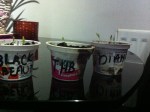
Tres hative barbentane is allegedly a variety that doesn’t mind cooler temperatures, so this is a possible test. I think when I was researching aubergines, these were the varieties that fell into the most pragmatic to grown, given the British Climate. There are of course, many different varieties available. Three seeds of each have been sunk into labelled yoghurt pots and placed into the heated prop. The same method used as the chillies. They may take just as long as chillies to germinate. If the window sills were a little warmer and there was a but more light, I would have put them on the window sill.
The aim of this experiment remains the same. To get a single solitary fruit, from any of the different varieties. Firstly, the things have to germinate.
Over the last two weeks, it has been rather difficult to walk down to the plot. Mainly as the weather has been atrocious, but also as I start a new post. The sum of any visits has been to wander down there in the red wellingtons and see if the puddles have got any deeper. One takes one’s life into one’s hands just getting down the path. Sadly, there is no money in the site budget to fix it. I grumbled about that a fair bit at the plot meeting. It is turning into a health and safety hazard. The plot itself, is a maze of puddles; as you will see from the videos. Which is why there are so many raised beds. The benefit of the rain, is that I can see where I need to build things up. The plot is actually lower than the path that runs alongside.
The plot cuts something of a post-apocalyptic scene in the desolate dire winter. A stark contrast to the flourishing flowering scene in the summer gone. I must remember to sow the sunflowers for the Sunflower project 2014. I encourage to think about that, a good cause and it makes the plot look oh so pretty!
I know that the for the last few weeks, all the updates have been somewhat miserable. Sadly, I cannot control the weather! The growing season is still in it’s infancy.
Took a walk down to plot 2 today. Wanted to update you all on just what was happening. Very cold, but very bright. Just not very playable though.
Bit of sunshine, lots of puddles. So much to clear up.
I have battled with the topography of the plot. It is lower in the middle, than everywhere else. Water forms puddles, that then just stand and stay there stagnating. The key has been raised beds. I can safely say, that they have been very useful. Allowed me to get growing, and be successful with it. last year, three beds were full of potatoes. The spuds worked reasonably well, I got potatoes, that was good enough for me. However, there was a lot slug damage to them. The beds were filled with assorted organic matter. Grass cuttings, horse poop, and leaf mold. This year, the beds have sunk; as they do. So will need to have more material added to them.
There are onions, shallots and garlic in there somewhere. These were all planted through cardboard. I would have expected to see a bit more top growth by now, but these were planted a whole month later than expected. In addition, there has been a lot of rain. I can only hypothesis that the roots are being set down, at least by those sets that have survived the wet and inclement weather.
Leaf mold! This was all collected last year, and is cooking in the cold. There are two aims for this stuff. To first use in the raised beds, and there are quite a few raised beds. Then to put what remains where I can, to improve the soil and help raise the open ground areas. Last year, one entire builders bag was used to fill a 1mx2m bed. This bed was then used to cultivate two courgettes and marrows. I can safely say, that the decaying matter did them wonders. Prolific anyway, the squashes somewhat thrived with all that leaf mold.
A little more progress has been made this week on the magic square project. We are now up to six panels, with a seventh in progress. They are all a bit wonky, but I am trying to keep them all all roughly the same size. They all have seven stripes, so are uniform in that respect. I still have a fear over knitting patterns, looked over a book that ma has with lots of different stitches,and that just made my brain hurt.
Apologies for my absence, this week has seen a return to work and the inclement allotment weather continues. As I write this, there is a spittar splatter of rain across the window panes. The plot is most likely under puddle of water. This means that any growing is inside.
Above is an image of the experimental chillies and one of the superhots-serrano. Cayenne and California wonder have been amongst the casualties. Cayenne failed to germinate, and california wonder fell in germinating but not being able to exit its seed case. Dorset Naga and one choc habanero has done the same, and have both been resown, A little frustrating, but the slowness of these two germinating and then not getting any further should have been somewhat telling.
On a second window sill, orange habanero and tobasco are sitting still. I worry about the tobasco, some of its very tiny baby leaves snapped off as it was exiting its seed case. So that one will be somewhat touch and go as to whether it does actually survive. It may be that the leaves are two small to photosynthesise for the seedling.
You will note that the pots are still in foodbag cloches. A retaining security measure; if they get cold with a drop of temperature in any impending cold snap, they may well keel over. I would much rather they didn’t. In the heated prop, we are awaiting fire, scotch bonnet yellow and choco habanero.







 horticultural 'obbit