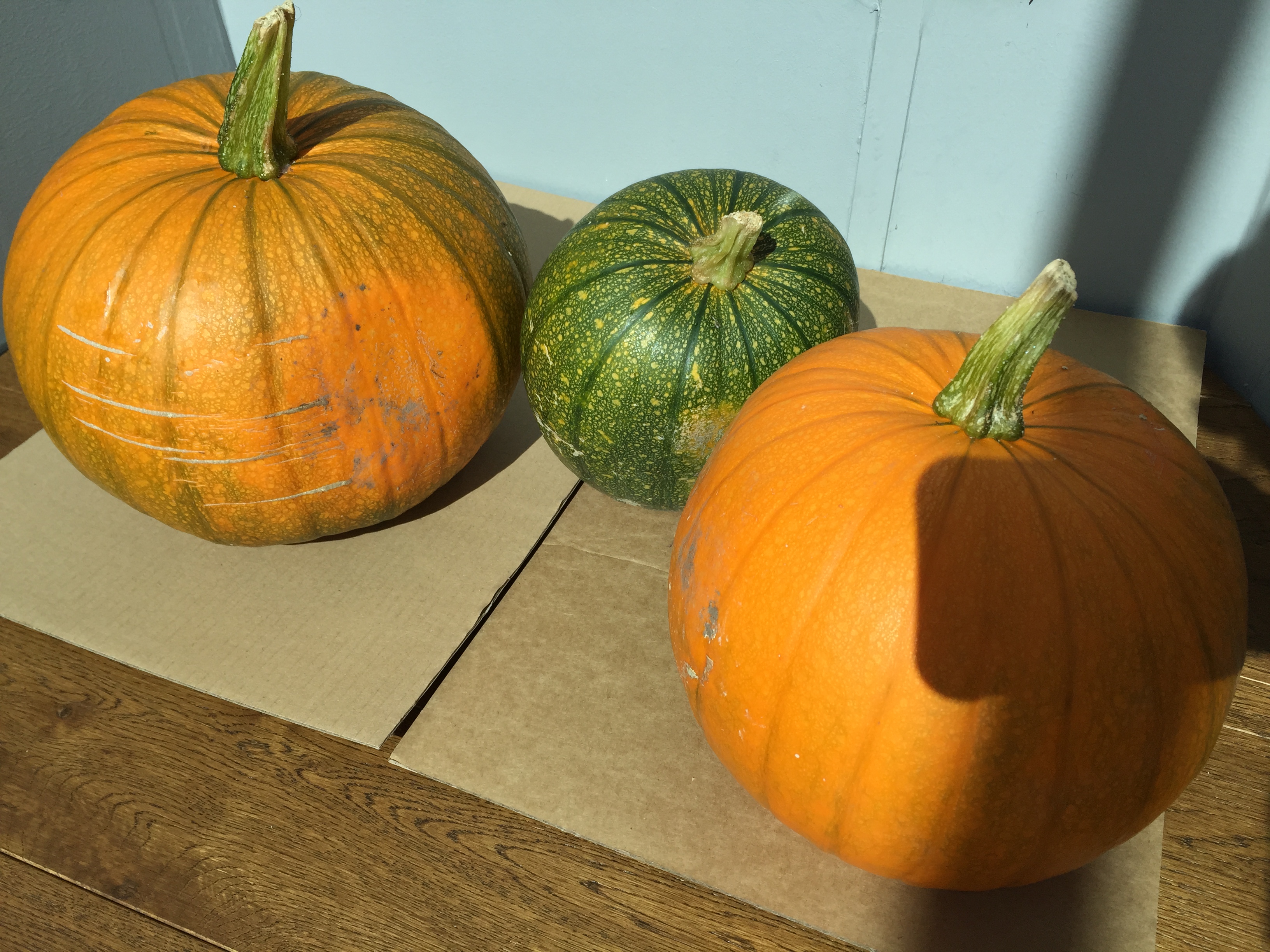
My Bruno is the one on the left. The other two have gone to loving homes, with the middle one having met it’s soupy and curried end.
But what to do with mine?
In the past, we have curried, and souped. We’re not really a sweet pudding family, so I am not sure about making a pie. And we don’t tend to turn him into a lantern.
Playing a bit of catch up with NaBloPoMo, it’s hard being a couple of days out of sync. This time last year, I wrote about how I might write a book. Frequent readers will know that I did, and it is available in both ebook and print.
The book, like me, is born in Britain. It’s subject matter is an allotment in the middle of England. Not Middle earth, middle of England. Britain has a thriving gardening community, that is incredibly diverse. From the amateur allotmenteers like me, to the more seasoned and professional Gods of Horticulture.
So when it goes to the US, that is something beyond my original aspirations. Serendipity books and more have agreed to stock a handful of copies, and that is pretty damned amazing.
Then there are the reviews:
ebook review
paper back review
Not bad are they? It was incredibly scary writing and then publishing. There was certainly a sensation of having sliced off a bit of your soul and sent it out into the universe. So it is very, very, very encouraging when people buy the book and review it. Tells me what they have got out of something that I am very proud of having created.
If you read it, even the sample, then please share it. Review it, put it onto your Goodreads thingy.
It’s miserable outside, and there is a distinct absence of colour. Over the summer and indeed the last few years, the plot roses have come into their own. The bushes are becoming more established, and this has meant that we’ve had an abundance of blooms to sit upon the kitchen window sill.
I have a combination of posh roses, roses that I know the name of; as well as lost label roses that are nameless. In the middle of the plot, I have William Shakespeare 2000. A beautiful bloom that I got for birthday eighteen months ago. At some stage I will add Anne Boleyn to the plot. There is just something about having roses on the plot. The colour and the scent add a great deal of character to the plot that is otherwise used mainly to grow fruit and vegetables.
Remember that green pumpkin above, the little green one?
Well, I have that to my aunt. It had turned orange over the last few weeks and she was ready turn it into something edible. So today as an early diwali present, she handed me these.
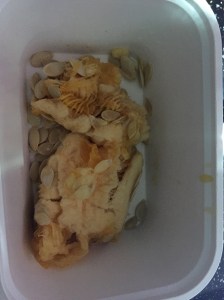
Seeds. I had asked her to save them for me. The plan, as with all bruno seeds, is to save them, dry them; and send them to loving homes for next year. The seeds were in one hand, in the other was a tupperware box of pumpkin soup. So two presents, for the price of one.
Bruno, one of three, has come full circle. From being a seedling, to a heavy vine, from which we harvested a fruit. To curried and souped, with his seeds now drying.
Bruno, one of three, you actualised your potential.
I like colouring. Over the last week, I have spent lots of time after work, colouring as a wind down activity.
I have spent two days working with the students that I support and using colouring as a mindfulness activity. For some, it was rather novel; they had never coloured before. For others, it was a throw back to their childhoods. There were even those, who really didn’t like the experience. Good feedback, for the latter; for future reference.
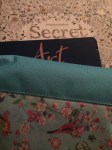
I did actually confess to them, that whilst I was just over thirty; I enjoyed colouring. Brandishing my copy of ‘The Secret Garden’, I flicked through the pages that I have coloured to date and modelled, if you like, what a possible result might be for them. Modelling is good, success criteria, if you like, of what students might achieve. This is what all teachers are supposed to do! Model a successful outcome for their students to aim for.
That however, was not my only aim. I was also asking them to experience mindfulness. To sit, reflect, and be aware of their own processes. This was how I started my sessions, as the aim, the objectives if you like, again, this what we are supposed to do in starting our lessons! Sorry, I know it’s odd. How can I address this as a lesson? Such is the world of teachers, everything has to be organised as such.
I found it a really valuable experience. Students were able to say how they felt it, there were a number who did enjoy it and wanted to do it again. A few, but not many; would not want to do it again.
With the leaves falling and autumn kicking in. It is very easy to get annoyed with the litter of golden leaves that form in small mounds on the pathways and roads.
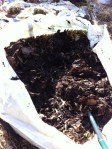
Over the last few years I have been using nature’s refuse to fill the dozen or so raised beds on the plot. Whilst is not particularly full of nutrients, it does have it’s uses. I use it as filler so I don’t have to spend a small fortune on multi-purpose compost as the levels of raised beds decrease over time. Leaves are dumped to decay over the autumn and winter months, and then in the spring, I cover with multipurpose compost.
Leaves are gathered up Dad and put into gardening bags. Dragged down to the plot, these the fill the beds along with any other organic material such as grass cuttings. I have in past, put thirteen or so bags into a one tonne builders bag. This over the course of eight months has then decayed down into a soil like consistency. As mentioned above, there is very little nutritional value. Leaf mold is therefore best used to improve the structure of soil and bulk it out.
One year I used one builders bag in a raised bed that was planted up with marrows and courgettes. I can safely say, that the plants grew exponentially, because of the decaying material.
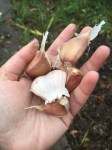
The second batch of garlic is from The Garlic Farm. This summers crop was by far one of best I have had had, so for me having them again was really a good way of trying to replicate that success for next year. Hopefully it will be just as successful. I was really surprised, and impressed, by the size of the bulbs that cropped. Also there is a real and definite difference in the flavour and strength of home grown garlic compared to that bought in the supermarkets.
picardy wight (I had to resist saying ‘make it so’ as i planted this one)
Vallelado wight
early purple wight (we’ve had this one before)
Provence wight
Solent wight
This batch has been sunk into two raised beds. I had thought that I had too much garlic. As though such a thing might be possible! The worry had been that there wasn’t space. Turns our there was enough space and more. I have saved the elephant garlic to share with my aunty, for some reason it bolted on my plot this year.
At least now all of the autumn garlic has been planted. May be, just maybe, I might try a spring batch.
Thanks to Marshall Seeds who kindly send me some heritage garlic varieties; and start with with arguably the first planting for next years growing season.
In general, Heritage fruit and vegetable varieties are still very new to me. Something that I tried to do this year and am looking to carry on into the future. Garlic is no different. It is staple part of many Indian dishes, and Ma will always use the crops that we produce on the plot in her kitchen.
Over the years, I have sown and grown many different varieties. The varieties in this batch are:
Red Duke
Garlic Mikulov
Garlic Bohemian rose.
I have broken up the cloves from the bulbs. Each individual clove is then dibbed into the freshly dug over earth that we prepared last week. I say we, but in reality it was my mum digging it over and removing the weeds and grass that offended her by just growing. She doesn’t the weeds and is always trying to make the plot what she terms to be ‘tidy’, I do not know how the grass even dares, in knowing that it will be unscrupulously pulled out.
I am conscious that there is a risk of bird pulling the cloves out, so they are covered with only the tiniest bit of clove sticking out. Hopefully, they should be okay.
In the freezer, we have enough beans to keep us going a for a while. That’s a lot of curried beans between now and the start of next summer.
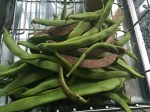
There was scarlet emperor running beans as well as the painted lady variety. The former being something of an allotment staple. Formed at least four out of the six wig wams that were on the plot. The other wig wams were a combination of blue lake and cobra climbing french beans as well as borlotti beans. These were what mum described as being the funny coloured bean.
The beans were sown in two batches. The first batch were sown to get the growing season started, and I somewhat ignored and underestimated their eventual yield. A couple of wig wams would probably have been sufficient, but that would have meant choosing one variety over another. A somewhat difficult choice. We like both climbing french beans and runner beans, so the scarlet emperor variety are always going to be sown. The difficulty lies in choosing between blue lake and cobra.
The borlotto beans were rather cool, if only for ma thinking they were a bit cute. I would like to look at purple climbing frenc bean if they exist. I know that they exist in the dwarf variety, but have yet to find a climbing variety.
And chutney. Runner bean chutney is meant to be nice.
That is what happened to the assortment of potatoes that the allotment plot yielded this year.
lady balfour
Pink fir apple
aloos! International kidney
There were a number of varieties that sunk on the plot, in the raised beds. We had international kidney, lady balfour, pink fir apple, kestral and red duke of york. The red duke of york were a bit hit and miss having been sunk into the earth in the poly tunnel by way of experiment. I don’t think I will be doing that again.
All the other varieties were sunk into raised beds. These were filled with either leaf mold topped off with multipurpose compost or well rotted and very crumbly farmyard manure. I did this as drainage is an issue with the heavy clay on the plot. In the past, heavy clay has basically eaten the seed potatoes in having caused them to rot due to excess water retention. With raised beds, the drainage is some what improved, and the seed potatoes like sleeping under nice organic material.
Internatioal kidney were cute and bountiful, lots of small round, creamy white potatoes. Pink Fir apple had to be the most abundant, with pounds and pounds being harvested. On average, we harvested one 10kg bucket every week. About four or five harvests were made over the duration of the harvesting period. As you can imagine that is a lot of potatoes. That was even before the lady balfour potatoes were harvested. These, thanks to the farmyard manure, were something of a whopper crop. I have grown these before, but have never harvested potatoes that half the size of a football.
All of these really were mashed, chipped, roasted and boiled. Not to mention put into stuffed chappatis. And the varieties matter. Pink fir apples do go well into stuffed chappatis. Lady balfour make for interesting, sweet flavoured chips. They do also tend to get a bit sloppy when mashed, but do hold together when roasted.
I have never found potatoes to be simple, though for many allotmenteers they are. I was gutted one year when the heavy clay caused them to rot. I learned that they needed soft friable soil. Even then, I don’t earth them as is done traditionally.
The humble spud, seemingly simple; can actually be complicated.



















 horticultural 'obbit